
End the philosophy of plunder and the philosophy of war will be ended as well.” – Fidel Castro
To: The Editor,
The Australian Financial Review
Your entire back page (Jan. 6) to the wealth expected from copper in the Congo. Not a word about the sixteen million Congolese lives sacrificed in resource wars since ‘independence’ in 1960.
Humphrey McQueen
Griffith
ACT 2603
Patrice Lumumba, the only leader ever democratically elected in Congo, was delivered to his enemies, tortured and summarily executed. Lumumba, a democratic and strong African leader, was killed by Belgian officials with the help of the CIA. Since then, his country has been looted by the U.S.- supported regimes of Mobutu Sese Seko and now by DRC president Félix Tshisekedi). The Congo is wracked by regional and civil war.

De Witte argues in The Assassination of Lumumba that the United States and Western Europe, fearing that the former Belgian colony would turn to the Soviets following independence, were complicit in plotting Lumumba’s assassination.
PATRICE Lumumba’s sons are seeking justice for their murdered father: “Francois, Roland and Guy Lumumba deliberately chose the build-up to the anniversary [50th anniversary of independence) to announce their plan to prosecute surviving Belgian officials allegedly involved in their father’s death. Guy, the leader’s youngest son, said: “I want to know how he died. There are many books I can read and everything has been said, but there is no justice.”
Here is the AFR article Why the US wants BHP and Rio to get crazy rich in the Congo referred to by Humphrey McQueen in his letter to the editor of the Australian Financial Review.
As a journalistic device, the author Robert Ker references the populist stereotypes in the Hollywood film Crazy Rich Asians to highlight what is going on in the former Belgian Congo. He would have been better advised to look deeper.
The film, The Passenger by Michelangelo Antonioni, purported to show the actual footage of the murder of Patrice Lumumba. It is almost certain that this is incorrect.
It was an Irishman Roger Casement who in the 19th century gathered “evidence documenting atrocity after atrocity and producing a vast body of incriminating facts that made clear the Congo was an international crime scene. In a remarkable episode of double standards Britain the world’s most rapacious imperialist the country that over the previous 300 years had plundered more money out of its colonies than in the other that the crusade against imperialist Belgium at the head of the crusade was the Congo reform association with casement acting as morel’s chief advice casements official revelations reported widely condemned King Leopold and his slave colony to international approprium“. Money – a story of humanity by David McWilliams.
Accused of treason and homosexuality casement was hung in Pentonville prison on the third of August 1916. Casement was no Marxist he was a liberal and “a fair trade advocate and believed that those who extracted commodities such as rubber whether they be congoles or indigenous tribes in Peru should be treated humanly. He was against extractive capitalism and extreme exploitation. Part of a reforming tradition that was active at grassroots Revel level in both Island and Britain at the time casement was drawn to the possibilities of building a more socially just world full stop the anti-colonial movement he champion became one of the most significant political forces of the 20th century and is Genesis lay in the atrocities of the previous race centuries most carried out in the pursuit of money although it was not obvious at the time the trial of casement was a privilege of pivotal moment.” – Money by David McWilliams.
Ian Curr, Ed., 7 January 2025
__oOo__
Why the US wants BHP and Rio to get crazy rich in the Congo – Australian Financial Review, Jan 6, 2025.
If a sequel is ever made to the 2018 box office hit Crazy Rich Asians, it could well be Crazy Rich in the Democratic Republic of Congo. American billionaire Robert Friedland owned the film production company that made the former, and his flagship copper company Ivanhoe Mines is fast achieving the latter.
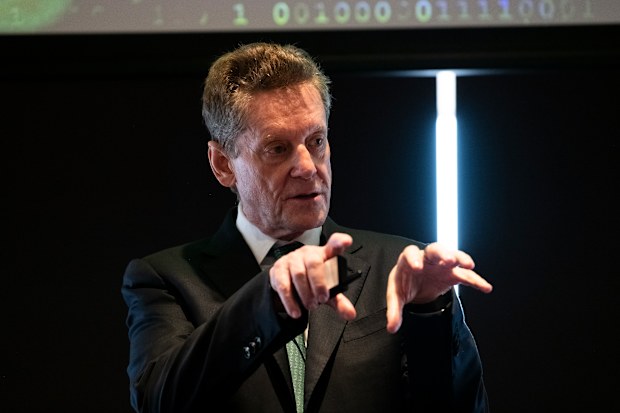
In the decade since Rio Tinto bought Friedland out of Mongolia’s Oyu Tolgoi copper project, the legendary explorer has found and built another of the world’s great copper mines, this time at Kamoa-Kakula in the DRC.
The dirt at Kamoa-Kakula is fabulously rich in copper and much of the power for the mine comes from carbon-free hydroelectric generators nearby.
Production has been under way for just over three years, but already Kamoa-Kakula is the world’s fourth-biggest copper producer. If expansions go to plan, it could sneak into second place by 2028.
At a time when BHP and Rio are hungry for copper and pulling the trigger on acquisitions, it’s curious that Ivanhoe and Kamoa-Kakula haven’t yet caught a bid.
Compared to BHP’s highly complicated attempt to acquire Anglo American last year, a bid for Ivanhoe – which owns 39.6 per cent of Kamoa-Kakula – would be simpler to complete and should be doable at half the price.
The big Australian miners are impressed by what Friedland has created in the DRC; a delegation from Rio have visited Kamoa-Kakula, and according to those within earshot, the delegation left the DRC thinking they had seen the world’s best copper mine.
Friedland has many admirers in the boardrooms of BHP and Rio. One person who serves as a director on one such board told The Australian Financial Review they consider Friedland “a genius”.
It’s not just Friedland’s ability to find copper mines that has impressed; Friedland’s work on “pulsed power” has also got the big miners excited.
Pulsed power is a method of accumulating electrical energy over a long period then releasing it instantaneously; thereby compressing and concentrating it to deliver a greater force.
The Friedland camp reckons pulsed power could allow the mining industry to dramatically reduce the amount of energy it consumes when grinding and drilling through rock.
BHP chief executive Mike Henry was so impressed by pulsed power he bought BHP a stake in two of the Friedland companies trying to apply the technology; I-Pulse and I-Rox. Henry then made a personal appearance in a promotional video for I-Rox, describing it as a “breakthrough technology” that could “radically transform the way we go about the act of mining and processing”.
But as the deification of Friedland gathers pace, one senior executive from the big two Australian miners who sat down with the Financial Review on the condition of anonymity pointed out a fly in the ointment at Kamoa-Kakula – one that may explain why Ivanhoe has eluded potential acquirers.
It’s not so much about the DRC’s traditional reputation for sovereign risk; miners are generally encouraged by the way DRC president Félix Tshisekedi has prioritised investment into the DRC from American and European sources.
Tshisekedi has been rewarded by the US State Department for his perceived progress on human rights and anti-corruption measures, winning greater access to US markets under the Africa Growth and Opportunity Act (AGOA).
Senior people now believe the DRC is investible for the right project; an extraordinary notion given the DRC was a byword for corruption and child labour barely a decade ago. (These days, Mali is the place mining executives refuse to go, lest they be held hostage.)
Which brings us back to the perceived problem with Kamoa-Kakula: transport and logistics.
The mine is land-locked about 1700 kilometres from the coast as the crow flies.
The vast majority of the copper produced at Kamoa-Kakula over the past three years has been trucked up to 3000 kilometres to ports like Durban in South Africa, Dar es Salaam in Tanzania, Walvis Bay in Namibia or Beira in Mozambique.
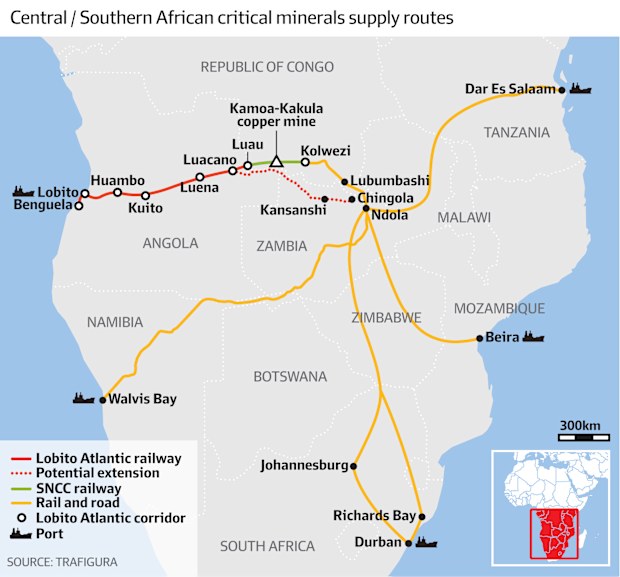
A return journey from Kamoa-Kakula to Durban often took 45 days, and rose to 70 days with congestion. Border crossings in Africa only create potential for complications.
The logistical cost of getting Kamoa-Kakula’s copper to port has been approximately 30 to 40 per cent of the mine’s C1 unit cost in recent years. According to Ivanhoe’s market filings, the C1 unit costs at Kamoa-Kakula were $US1.69 per pound in the September quarter.
That’s fairly competitive with the C1 costs BHP expects in the year to June 2025 at Chile’s Escondida (between $US1.30 and $US1.60 per pound) and its South Australian copper mines (between $US1.30 and $US1.80 per pound).
Those two BHP copper hubs are 170 kilometres and 560 kilometres from port respectively, and they also have shorter shipping journeys to customers in North Asia.
Ivanhoe reports another number called “cost of sales”, which was $US1.80 per pound in the three months to September 30.
That’s nothing to be ashamed of; it makes Kamoa-Kakula a cheaper mine than BHP’s Spence asset in Chile, and many of the world’s copper mines.
Two big efforts are under way to solve Kamoa-Kakula’s transport challenges and make it a lower cost producer.
Ivanhoe and its partners are building a smelter which will allow the mine to sell copper metal with 99 per cent purity, as opposed to the concentrate containing 50 per cent copper it mostly sells today.
The smelter will fire up in 2025, and selling copper with 99 per cent purity will mean Kamoa-Kakula doesn’t waste time and money transporting waste material to customers.
Ivanhoe reckons the smelter and the product switch could cut unit costs by 20 per cent and reduce the carbon intensity of each pound of copper by 46 per cent.
The US government is also determined to solve Ivanhoe’s transportation problems, and is pumping money into a 1739 kilometre rail and logistics corridor that will connect central African mines like Kamoa-Kakula to Lobito port in Angola.
The Lobito corridor is the US and European governments’ answer to China’s Belt and Road Initiative. It is designed to get African critical minerals to market faster, and to limit Chinese dominance of them.
The DRC overtook Peru as the world’s second-biggest copper producer in 2024, and Chinese companies like CMOC and Zijin are established players in the DRC.
Zijin is Ivanhoe’s partner at Kamoa-Kakula with a 39.6 per cent stake in the mine and 12.2 per cent of Ivanhoe’s shares. Chinese giant Citic owns 22.4 per cent of Ivanhoe.
The US government would dearly love for Ivanhoe’s stake in Kamoa-Kakula to stay in allied hands, lest China take control ahead of a decade when copper demand for decarbonisation and defence infrastructure is expected to soar.
It is no coincidence that the Lobito railway passes within five kilometres of Kamoa-Kakula, and the mine was among the first users of the railway when it sent trial volumes to Lobito in 2024.
Kamoa-Kakula is signed up to ship about half of its volumes to Lobito.
BHP and Rio have been heavily encouraged by their friends in the US State Department to get acquainted with the benefits of the Lobito corridor; the US funded rail network could be extended to help BHP and New York-listed Lifezone Metals develop the Kabanga nickel project in nearby Tanzania.
US President Joe Biden even travelled to Lobito port in early December, to observe its progress and pledge more money.
By this time next year, both the new smelter at Kamoa-Kakula and the Lobito corridor will be significantly advanced, and Ivanhoe’s logistics problems will be substantially solved.
Perhaps that will be the right time for BHP or Rio to get crazy rich in the DRC.

A Belgian court has ruled that a former diplomat can stand trial in connection with the killing in 1961 of Patrice Lumumba, Congo’s first prime minister.
Etienne Davignon, now 93, is accused of involvement in the unlawful detention and transfer of Lumumba and of his degrading treatment. Davignon was a trainee diplomat at the time and went on to become a vice-president of the European Commission, per the BBC.
📸 : AP photo, BELGA PHOTO BENOIT DOPPAGNE